Taxonomy: Geminiviridae, Begomovirus, Begomovirus citrulli
The most up-to-date and complete virus taxonomy is available on the International Committee on Taxonomy of Viruses webpage.
Watermelon chlorotic stunt virus (WmCSV) is an emerging whitefly-transmitted virus in the United States. It is a member of the genus Begomovirus in the family Geminiviridae. WmCSV can infect all major cucurbits, including bottle gourd (Lagenaria siceraria), cucumber, melon, pumpkin, squash, and watermelon (Ahmad et al. 2018, Plant Pathol. J. 34; Al-Musa et al. 2011, Virus Genes 43; Bananej et al. 2002, J. Phytopath. 150; Kheyr-Pour et al. 2000, Phytopath. 90). The virus was first identified in Yemen in 1986 and subsequently spread throughout the Middle East (Bedford et al. 1994, J. Plant Pathol. 100; Lecoq, 2017). WmCSV was first detected in North America in 2017 in watermelon in Mexico (Domínguez-Durán et al. 2018, Crop Prot. 103) and in cactus (Opuntia cochenillifera), lamb’s ears (Stachys byzantine), and a Solanum plant in a botanical garden in Arizona (Fontenele et al. 2021, Viruses 13). WmCSV was not recognized as a cucurbit production concern in the United States until it was detected in watermelon and melon in Arizona and California in the fall of 2023 (Wintermantel et al. 2024, Plant Dis. 108). It is now well-established and widely prevalent throughout the southwestern desert melon production area of these states.
Symptoms of WmCSV in cucurbits develop approximately 15 to 20 days after infection and vary among cucurbit hosts. Among cucurbits, watermelon exhibits the most severe symptoms (Abudy et al. 2010, Isr. J. Plant Sci. 58).
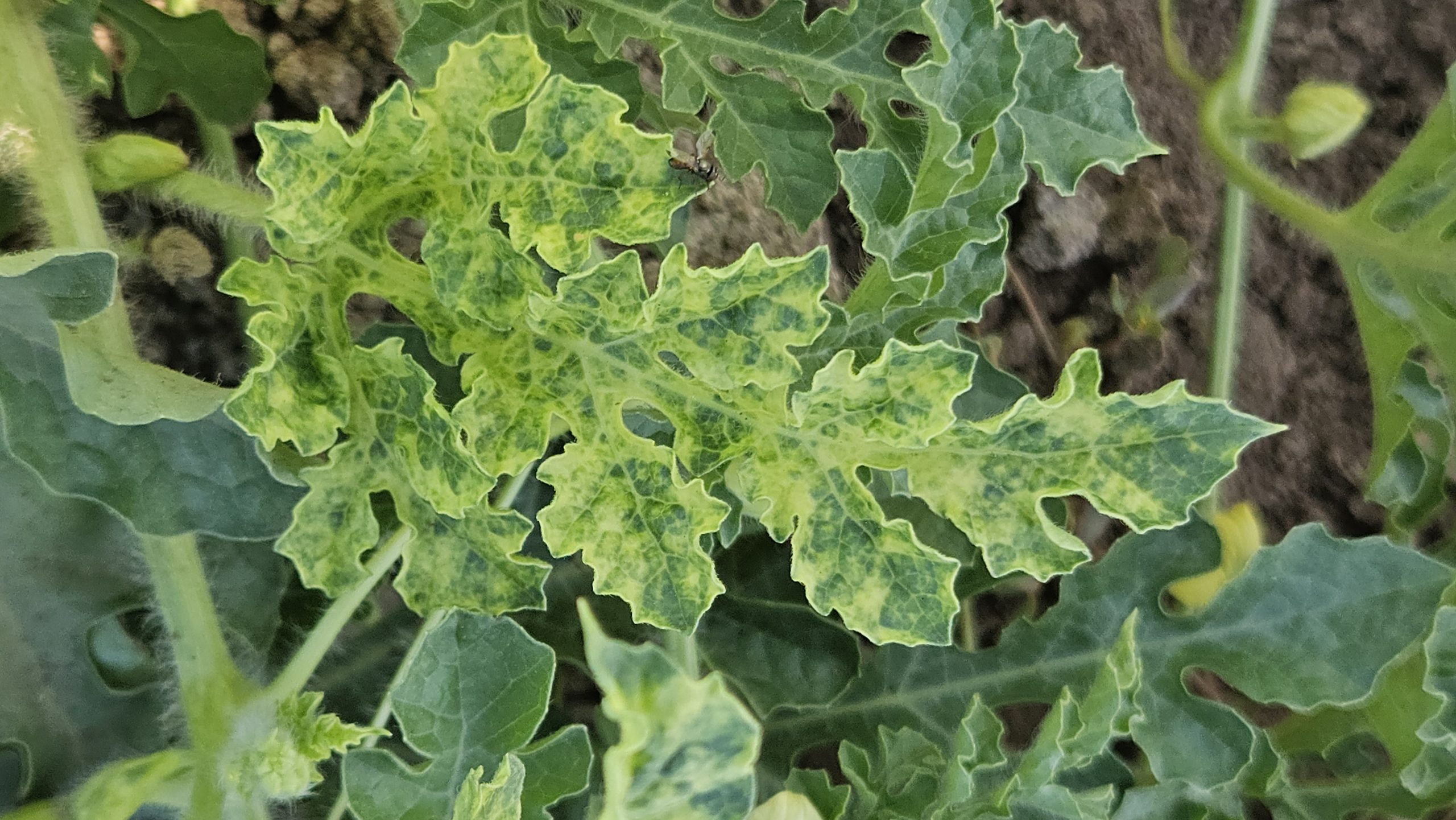
On watermelon, symptoms begin with mild to bright yellow vein clearing (Figure 1) and downward curling of leaves near vine ends and progress into a blotchy, chlorotic mosaic with some leaf distortion (Figure 2; Abudy et al. 2010). Young leaves of infected plants may remain small and not fully expand. Mosaics and scarring have been observed on fruit of WmCSV-infected plants in the field, but these symptoms have not been confirmed experimentally.
On melon, symptoms of WmCSV infection typically include irregular interveinal chlorotic patches on leaves that range from yellow to white (Figure 3) and may be accompanied by mild leaf distortion (Ahmad et al. 2018; Wintermantel et al. 2024).
Symptoms on bottle gourd, cucumber, and squash include interveinal chlorotic patches and lesions, leaf curling, and some reduction in leaf size on new growth (Ahmad et al. 2018; Al-Musa et al. 2011; Lecoq 2017).
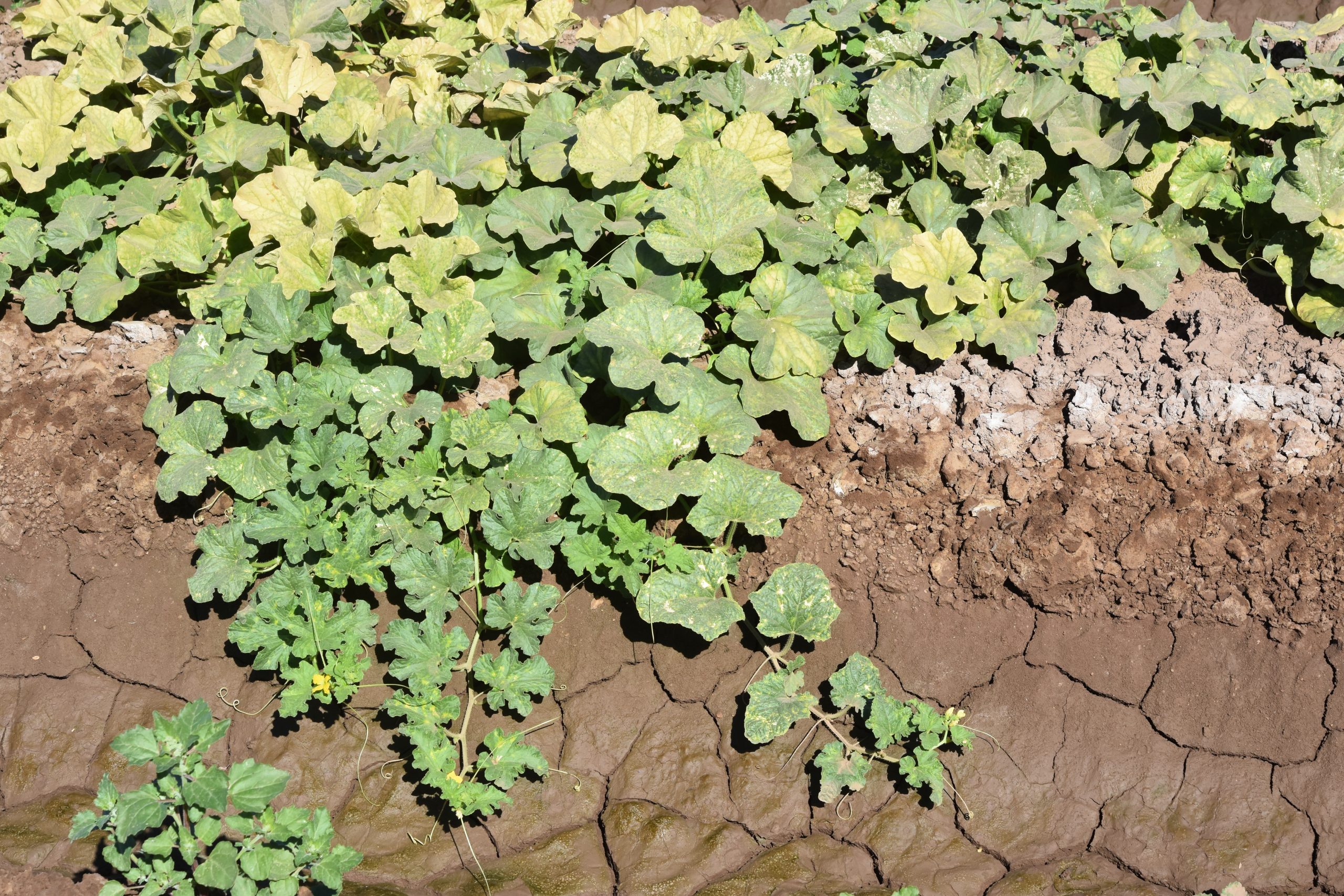
When WmCSV occurs in mixed infections with other viruses in cucurbits, plants may exhibit more severe symptoms or a combination of symptoms caused by the viruses in the mixed infection. For example, squash leaf curl virus (SLCuV) typically causes chlorotic lesions and very mild leaf curling on melon, and plants often recover within three weeks of initial symptom development; however, melon plants infected with both SLCuV and WmCSV exhibited increased symptom severity (synergism), including significant reductions in plant growth and fruit yield compared to infection with either virus alone (Sufrin-Ringwald and Lapidot 2011, Phytopath. 101). In the melon and watermelon fields in the southwestern United States, where WmCSV occurs frequently in mixed infections with the criniviruses cucurbit yellow stunting disorder virus (CYSDV) and cucurbit chlorotic yellows virus (CCYV) (Wintermantel et al. 2024), plants with mixed infections typically exhibit yellowing of leaves beginning at the crown and progressing down the vines (characteristic of CYSDV and CCYV infection) as well as chlorotic patches on leaves near vine ends (characteristic of WmCSV infection) (Figure 4).
Symptoms of WmCSV infection in cucurbits may be confused with symptoms caused by other cucurbit-infecting begomoviruses, such as tomato leaf curl New Delhi virus (ToLCNDV) and melon chlorotic leaf curl virus (MCLCuV), which are not known to be present in the United States (Brown et al. 2007, Plant Dis. 85; Cai et al. 2023, aBiotech 4). Mottle and mosaic symptoms caused by WmCSV infection may also be confused with those resulting from infection by other mosaic-inducing viruses, such as cucumber mosaic virus (CMV) and watermelon mosaic virus (WMV), which are widely prevalent throughout the United States (Adkins et al. 2025).
WmCSV is transmitted by adult sweetpotato whiteflies (Bemisia tabaci MEAM1 (formerly biotype B) as well as other B. tabaci cryptic species or biotypes. Whitefly transmission of begomoviruses, such as WmCSV, occurs in a persistent, circulative manner (Czosnek et al. 2017, Viruses 9). Begomoviruses are acquired by the whitefly as it feeds on plant phloem. Once ingested, the virus passes through the insect digestive system and into the hemolymph (circulatory system) of the whitefly where it becomes circulative. The virus accumulates in the salivary gland of the insect where it can be transmitted to plants as the whitefly feeds and egests virus-containing saliva (Czosnek et al. 2017).
Although various laboratory studies using agroinoculation have demonstrated that the begomoviruses cucurbit leaf crumple virus (CuLCrV) and ToLCNDV, can be seed-transmitted (Dhadly et al. 2025, Plant Dis. 109; Kil et al. 2020, Plants 9), another study demonstrated that ToLCNDV was seed-borne (virus present within or on the surface of the seed) but not seed-transmitted (Fortes et al., Plant Dis. 107). Despite these findings, there has been no evidence to suggest that begomoviruses, including WmCSV, are transmitted through seed under natural conditions. WmCSV is also not transmitted mechanically.
As previously mentioned, WmCSV can infect all major cucurbits, including bottle gourd, cucumber, melon, pumpkin, squash, and watermelon. Interestingly, however, some isolates were not able to infect cucumber (Ahmad et al. 2018; Bananej et al. 2002). Limited host range studies conducted in the United States have demonstrated that WmCSV has a wide host range among common weeds and other crops in the Southwest. Studies involving field sampling and experimental inoculations using whiteflies identified at least 26 plant species in 10 taxonomic families, many of which are perennials in the desert environment, as WmCSV hosts (Wintermantel and Discua-Duarte, unpublished). Although the suitability of these plant species to serve as WmCSV reservoirs is not yet known, reservoir hosts play a critical role in maintaining the virus from season to season, especially when whitefly populations are small and cucurbit crops are absent.
Although the source of WmCSV introduction into North America is not known, its ability to infect a broad array of native Sonoran Desert plants, along with the presence of large whitefly populations, likely contributed to the rapid establishment of WmCSV in the region and its introduction into melon and watermelon. This illustrates the importance of preventing virus introduction into a region in order to avoid its establishment.
WmCSV is frequently found in mixed infections with other whitefly-transmitted viruses in the southwestern United States, most frequently with CYSDV and CCYV (Wintermantel et al. 2024). It is not possible to determine from symptoms if one or more viruses are present in a plant; molecular diagnostics are needed to determine if a mixed infection is present and which viruses are present in the infection.
:Since its initial detection in Yemen in 1986, WmCSV has been identified in many parts of the Middle East where it occurs in association with the sweetpotato whitefly (B. tabaci MEAM1 or the related cryptic species the Mediterranean whitefly (MED, formerly biotype Q)). Since 2023, WmCSV has become prevalent in the Sonoran Desert region of the United States and Mexico.
Note: Years in parentheses indicate when WmCSV was first identified in that location.
For the most up-to-date information on geographical incidence, please visit this website (www.eCucurbitviruses.org), EPPO Global Database, or CAB International’s Invasive Species Compendium.
Symptoms alone cannot be reliably used to diagnose WmCSV infection. Diagnosis requires molecular or serological protocols that are commonly used in many research and diagnostic laboratories. While symptoms may be indicative of WmCSV infection, particularly in areas where the virus is known to occur, the prevalence of mixed virus infections, which are becoming increasingly common in cucurbit production areas, makes diagnosis difficult.
WmCSV is a begomovirus (taxonomic group in the family Geminiviridae) with two DNA particles, DNA A and DNA B, each encoding different genetic functions. When reporting WmCSV in a new location, assays that detect the presence of both DNAs should be used.
Molecular assays have been developed for the detection of WmCSV and include PCR (polymerase chain reaction; Ali-Shtayeh et al. 2014, Viruses 6; Wintermantel et al., 2024), qPCR (quantitative PCR; Kollenberg et al. 2014, PLoS One 9), and dot blot hybridization (Sufrin-Ringwald and Lapidot 2011). RCA (rolling-circle amplification; Inoue-Nagata et al. 2004, J. Virol. Meth. 116), followed by PCR with WmCSV-specific primers may also be used to detect WmCSV (Ali-Shtayeh et al. 2014). Serological methods have also been developed for the detection of WmCSV and include tissue print immunoassays (Kheyr-Pour et al. 2000) and a TAS-ELISA (triple antibody sandwich enzyme-linked immunosorbent assay) detection system, the latter of which is commercially available.
PCR with degenerate primers may be used for the detection of geminiviruses or begomoviruses but must be used along with sequencing and sequence analysis to determine the specific virus identity (Rojas et al. 1993, Plant Dis. 77; Wyatt and Brown 1996, Phytopath. 86). Similarly, antisera for the general detection of begomoviruses is also available and may be used for preliminary investigation, but this only confirms the presence of a virus in the Begomovirus genus. Specific begomovirus detection requires subsequent molecular testing to confirm which begomovirus is present.
Contact your local plant diagnostic laboratory to determine testing capabilities.
Visit the EVCWG website for a list of diagnostic laboratories in your state or for protocol publications and/or references describing appropriate WmCSV detection methods.
Although some sources of WmCSV resistance have been identified in Citrullus colocynthis, a wild relative of watermelon, and melon (Cucumis melo), resistance does not currently exist for any commercially produced cucurbit species (Yousif et al. 2007, Plant Breed. 126; Lecoq, 2017). Management efforts for WmCSV, like those for most other whitefly-transmitted viruses, should focus on use of virus-free transplants , suppression and avoidance of whitefly vector populations, and management of infected crop plants and reservoir hosts (Carrière et al. 2014, J. Econ. Entomol. 107; Carrière et al. 2017, J. Econ. Entomol. 110).
Transplants should be inspected and free of virus symptoms and all whitefly life stages (eggs, nymphs, and adults). When possible, do not import transplants from areas with a known presence of WmCSV or other whitefly-transmitted viruses as this can lead to introduction of whitefly-transmitted viruses to new areas.
Treatment of seedlings with an appropriate insecticide one to three days prior to transplanting can reduce infection by whitefly-transmitted viruses when transplanting into areas with elevated virus and whitefly incidence (Lecoq, 2017).
Planting into reflective silver plastic mulches can be effective in repelling whiteflies, particularly when plants are small (LaTora et al. 2022, Horticulturae 8).
An additional measure for field cucurbits can include the application of row covers – covering young plants with whitefly-proof mesh to exclude whiteflies while plants are young (LaTora et al. 2022). Row covers, however, must be removed in time for pollination.
It is important to limit whitefly populations in fields and greenhouses. Limiting the presence of whiteflies is important as sweetpotato whitefly feeding can kill young plants, as well as cause silvering on leaves of squash or pumpkin plants. If whitefly populations remain small or can be suppressed throughout the season, spread of WmCSV within or among fields can be limited or infections may develop late enough that yield impacts are marginal. Consult with guidelines for your production region to determine appropriate materials available for whitefly suppression.
Established fields of cucurbits or other agricultural crops, such as cotton, may serve as hosts to large populations of whiteflies. Removal of these fields may cause whiteflies to disperse to newly established or younger cucurbit plantings. Fields with whiteflies should be treated before destruction/removal and planting of new fields to suppress whitefly populations. This will reduce the potential for whiteflies to move to new fields or host plants in the area and may also reduce virus infections in the new plantings; this is particularly true when established fields have known infections of WmCSV or other whitefly-transmitted viruses.
In addition to suppression of sweetpotato whitefly populations, it is important to limit the presence of reservoir hosts, including weeds and other agricultural crops, known to become infected with WmCSV and from which whiteflies can acquire and transmit the virus to cucurbit crops. Removal of crops infected with WmCSV and infested with whitefly populations should precede planting of new cucurbit crops to avoid whiteflies carrying virus from one crop to the next.
Lecoq, H. 2017. Watermelon chlorotic stunt virus. In Keinath, A.P., Wintermantel, W.M., and Zitter, T.A. (eds.), Compendium of Cucurbit Diseases and Pests, 2nd edition (pp. 123-125). American Phytopathological Society Press.
Visit the EVCWG website for a complete list cited articles.
This work is a publication of the Emerging Viruses in Cucurbits Working Group (EVCWG). It may be distributed without alteration for nonprofit educational purposes provided that appropriate credit is given to the authors and the Emerging Viruses in Cucurbits Working Group. Permission for any other uses should be requested from the Emerging Viruses in Cucurbits Working Group.
Funded by the Southern IPM Center (Grant S24-048) as part of USDA National Institute of Food and Agriculture Crop Protection and Pest Management Regional Coordination Program (Project Award No. 2022-70006-38002). Any opinions, findings, conclusions, or recommendations expressed in this publication are those of the author(s) and should not be construed to represent any official USDA or U.S. government determination or policy.
Author: William M. Wintermantel, USDA-ARS.
Senior editor: Rebecca A. Melanson, Mississippi State University.
Reviewers: Sudeep Bag, University of Georgia, and Olufemi J. Alabi, Texas A&M University.
We value your time and feedback! If now is not a convenient time to complete this evaluation, you can find the evaluation link on the website homepage.